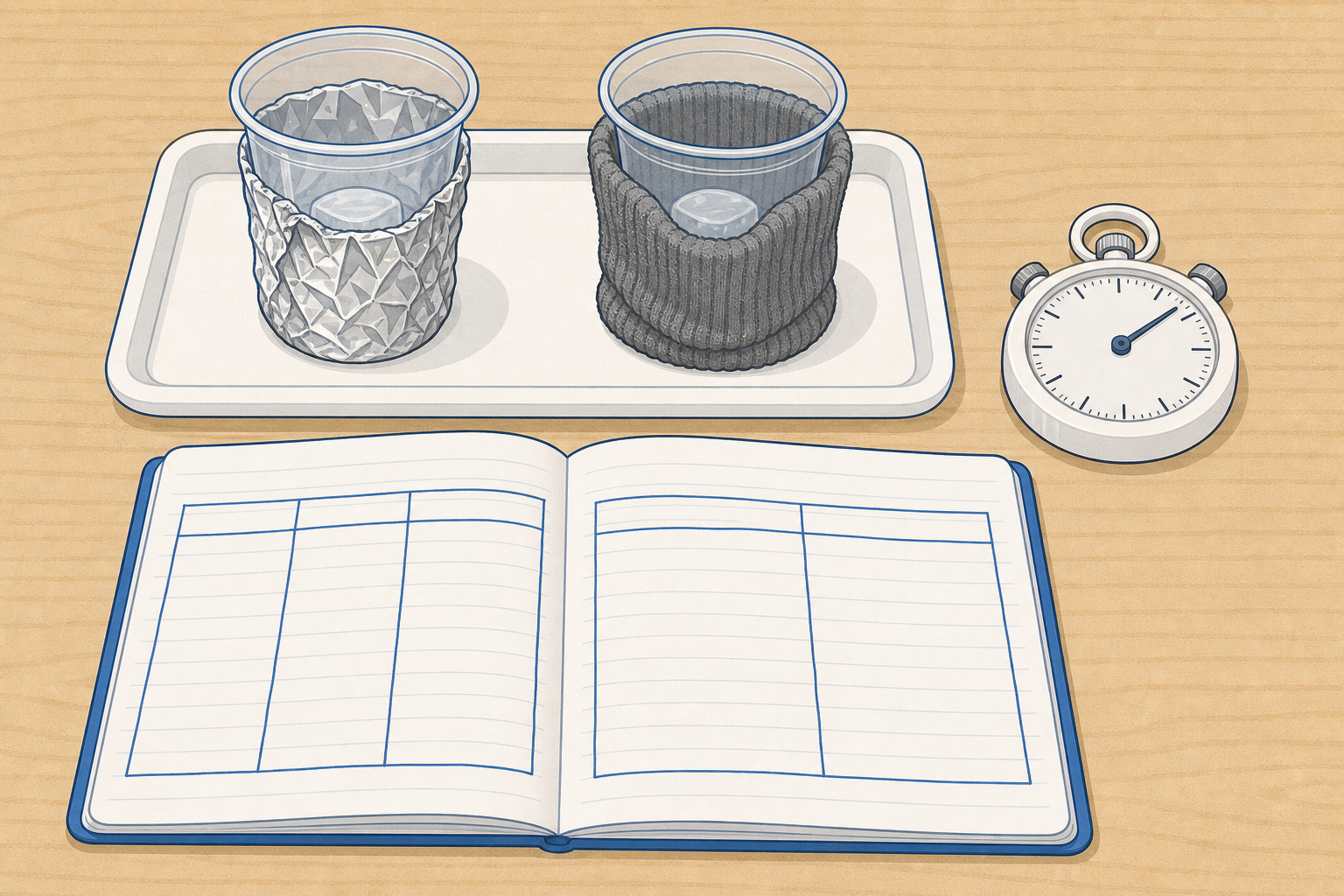
 Earlier in this project your group planned a heating or cooling fair test and ran the first trial. One reading can fool us. Why do scientists run a test more than once before they trust the answer?
One ice-cube time can be a fluke (a one-off lucky or unlucky result that never shows up again), like an 8-minute melt that never happens twice. That is why we repeat.
Repeat means we run the same fair test again with everything kept the same. Evidence is what the numbers show, not what we hoped would happen.
If Trial 1 and Trial 2 disagree, what should a careful scientist do next?
 Run your fair test again:
- Open your Investigation Journal at the page with your plan and your first trial reading.
- Set up the same fair test, using the measure or observation window written on your plan.
- Run Trial 2 and write the reading on that page straight away.
- Reset everything so the start matches, run Trial 3, and write that reading down straight away too.
Later you will only use trials that share the same measure and the same window. If today's window is different from Trial 1, your trustworthy number comes from Trial 2 and Trial 3 only.
 Watch this first. Three trial times that used the same measure: 8 minutes, 12 minutes and 11 minutes. Put them in order: 8, 11, 12. The middle value is 11. That is the number we trust more than any single trial.
Now open your Results and Conclusion page. Work through this checklist:
- First, copy across only the trial readings that used the same measure and the same window.
- Then write the middle value if you have three matching trials, or the pattern if you have two.
- Next, decide whether the prediction held, and write what the numbers show.
- Last, add one way you would improve the test next time.
Evaluate means deciding from the evidence whether the prediction held, and saying what you would improve. That is the last two things you write.
Every group's trustworthy number goes on one chart, so we can see the story the whole class tells.
We only compare groups that measured the same thing in the same way, so ice-wrap groups and warm-cup groups go up as separate charts. Which result stands out? What does the chart show that one notebook page cannot?
Our heating and cooling middle values
Unlock the full learning experience
You're previewing this lesson. Get full access to this lesson and hundreds more — each one ready to teach, with interactive activities, printable resources and pupil progress tracking built in.
This lesson is copyright of DigitalSkills.org 2017 - 2025. Unauthorised use, copying or distribution is not allowed.