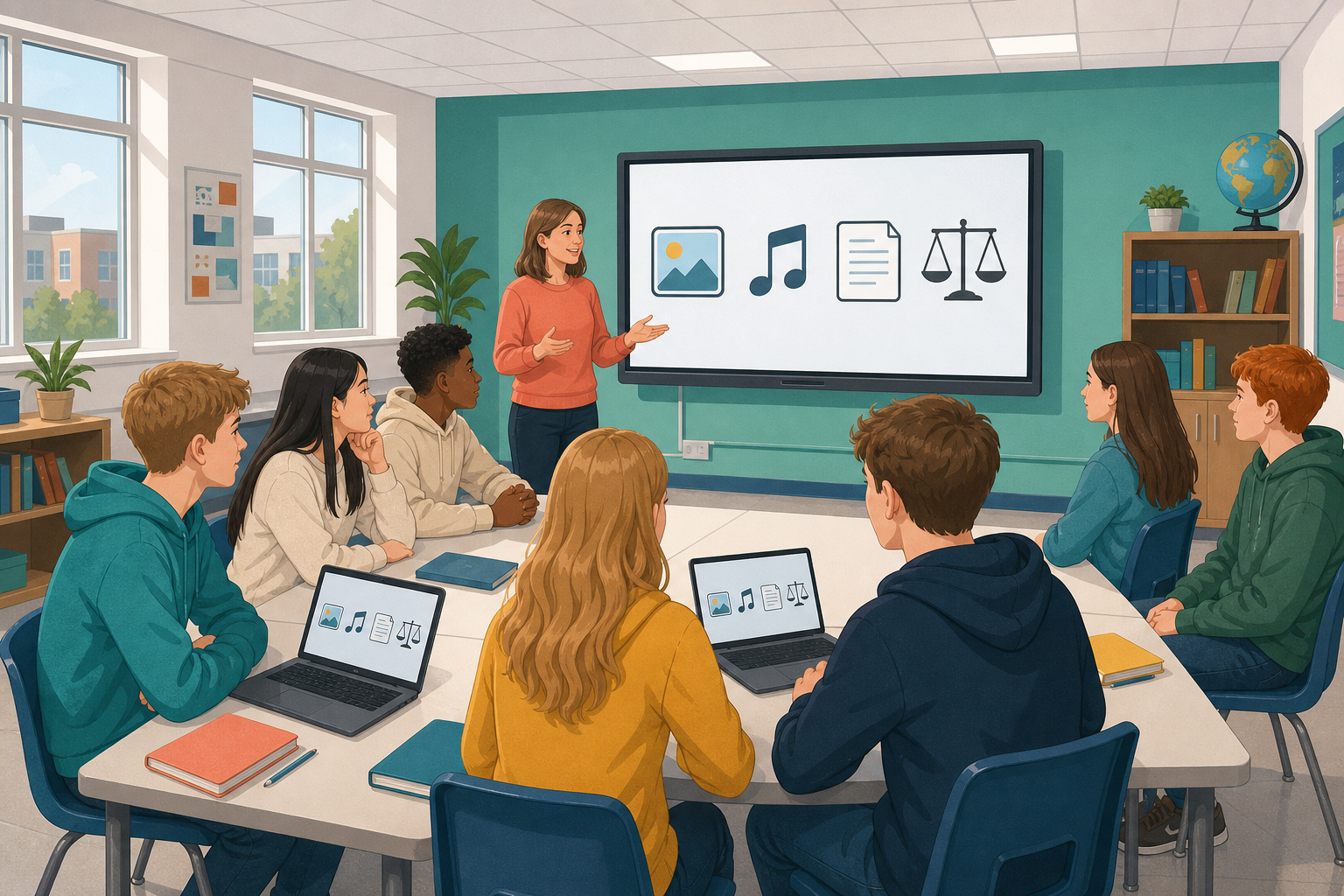
 Today you will think about reusing things you find online. When is that fair, and when is it taking someone else's work?
First you will sort some everyday examples into groups. Then you will look at a harder case where both sides have a good argument. By the end, you should be able to say in your own words when it is fair to reuse someone's work.
Ask these four questions every time you decide whether reusing something is fair:
- Who made it?
- How much are you taking?
- What are you doing with it?
- Have you been honest about where it came from?
Some cases are clear, but others are harder to call. For those, think them through with the four questions.
Your teacher will sort the first card with you on the board, and you will sort the rest yourself in Class Play.
The three boxes are:
- Fair to reuse, for example fair use. Fair use means using a small part of someone's work for school learning or to comment on it, usually with credit.
- Needs permission or credit. The use is nearly fine, but the maker's name is missing or you still need to ask.
- Plagiarism or infringement. The use is not OK. Plagiarism means handing in someone else's work as your own. Infringement means using the whole work, selling it or posting it publicly without the right to, even if asking first would have helped.
Fair or not?
In Class Play you sort the five cards on your device, one card in each round. Round 1 is a warm-up, because you did that card together.
For each card, pick a box and say how sure you are. Choose "just checking" if you are guessing, "fairly sure" if you think you know, or "certain" if you are sure. The surer you are, the more points you win if you are right and lose if you are wrong. You can change your answer until the time is up.
Your table scores when you get it right together, so you can talk quietly first. When the round closes, the board shows the right box, and your teacher asks for the reason.
Class Play
Now try a case that does not fit neatly into one box. The class will act as a tribunal, which works like a small court. Both sides argue, and then the class makes a decision called a verdict. Your teacher will tell each half of the room which side to argue.
Jamie makes a 90-second school project video reviewing a new game. Jamie records 25 seconds of their own gameplay and talks over it, praising and criticising the game in their own words. Jamie shares the video only with the class on the online learning platform. Nobody is paid. The game company's logo can be seen in the footage.
How the tribunal works
- Half the class builds the strongest case that Jamie's reuse is fair.
- The other half builds the strongest case that Jamie needs permission or risks infringement.
- Each side gives a one-minute argument.
- The class then chooses a verdict for now. It can be fair to reuse, needs permission, or still too unclear to say.
- Last, the class lists together the facts that would change the verdict.
Use the ideas for your side to get started. Intellectual property is work someone made and owns the rights to. Copyright lets them control who copies, shares or sells it.
- The video is for school learning and is a real review. It does not replace the game.
- Jamie added their own comments, so the video is a review, not just a copy of the game.
- Only the class can see it on the online learning platform, not the public.
- The 25-second clip is only part of Jamie's 90-second video, and Jamie recorded it while playing a game they already had.
- The gameplay and the logo still belong to the game company. They are its intellectual property.
- Twenty-five seconds in a row is quite a big chunk, not just a single still picture.
- Videos on a class platform can be passed on, so "school only" does not fully protect it.
- The company could fairly say it never agreed to this, especially with its logo on screen.
Before you finish
It is fine if not everyone agrees with the verdict. Try to find at least three facts that would change it, such as how long the clip is, whether the video is public, whether anyone makes money, and how much Jamie's comments add.
Unlock the full learning experience
You're previewing this lesson. Get full access to this lesson and hundreds more — each one ready to teach, with interactive activities, printable resources and pupil progress tracking built in.
This lesson is copyright of DigitalSkills.org 2017 - 2025. Unauthorised use, copying or distribution is not allowed.