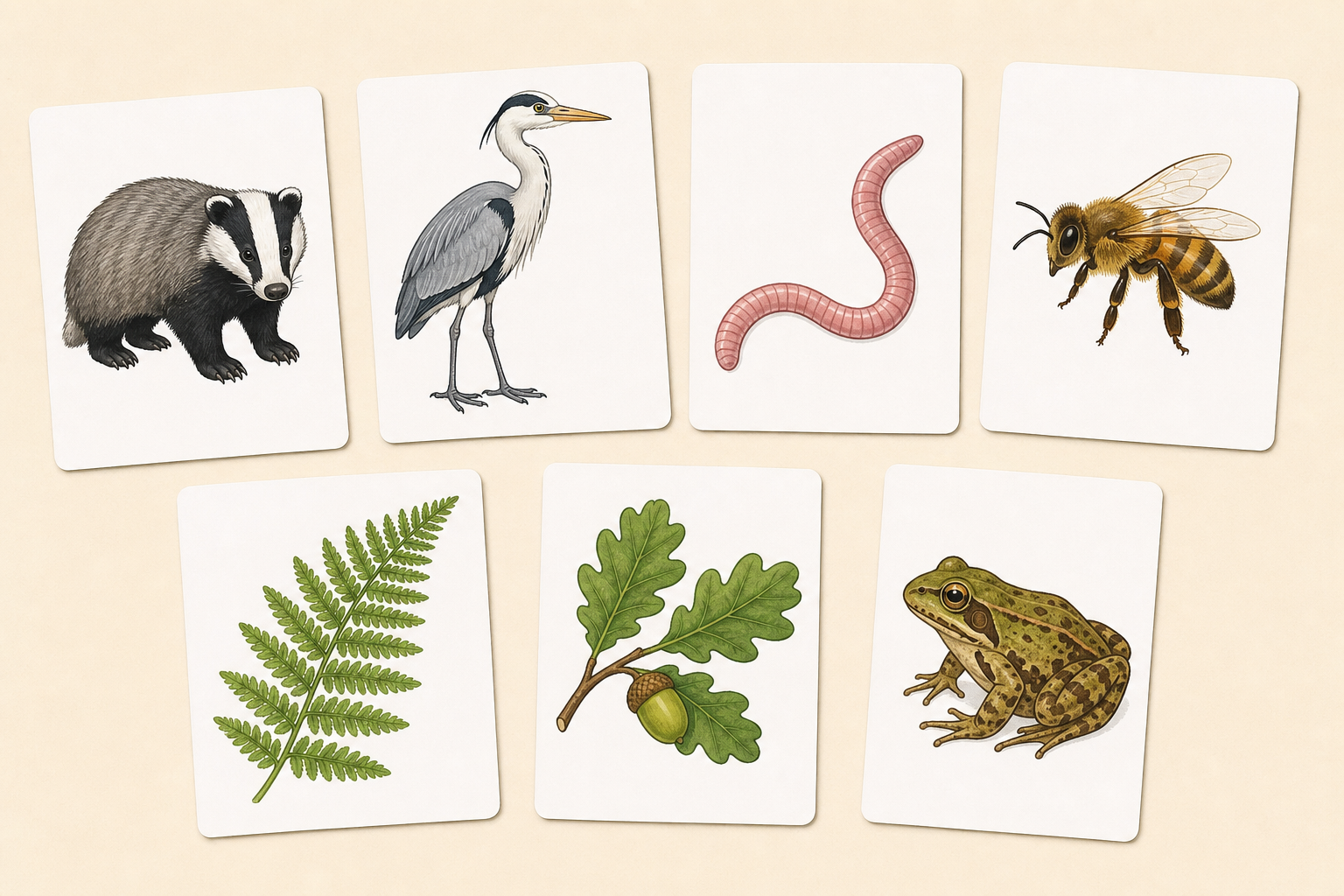
 Look at these seven Irish living things: badger, heron, earthworm, bee, fern, oak and frog. They are all different. What features could we use to put them into clear groups?
Look at our seven cards again. When we classify, we sort living things into groups that share a clear feature, and we say why each one belongs.
Try a quick first split with me: plant or animal? Oak and fern go one way; badger, heron, earthworm, bee and frog go the other.
The feature we just used is our criteria: the thing we chose to sort by. Which other feature could split the animal group next?
Now watch a branching key: a path of yes-or-no questions that splits a set step by step. Here are five minibeasts: worm, ladybird, spider, snail and ant. We will only sort them into clear leg groups for now, so you can see how a clean question works.
Which first question is better: "Does it have legs?" or "Is it colourful?"
Sort the minibeasts
Your group has seven Irish living things: badger, heron, earthworm, bee, fern, oak and frog. Choose the criteria you will sort by, from the four under Think about below, and use a feature you can check by looking.
Make a first sort into clear groups and be ready to say why each living thing sits where it does. Every card must have a home.
Write the criteria you chose, and your Question 1 with its YES pile and NO pile, on your Investigation Journal page.
Turn your sort into a branching key on one A4 sheet for your group, laid out like this example (it uses the minibeasts from the board, not your cards):
Criteria: body features
Q1: Does it have six legs?
YES path
Q2: Does it have hard wing cases?
→ yes → ladybird
→ no → ant
NO path
Q2: Does it have legs?
→ yes → spider
→ no → Q3: Does it have a shell?
→ yes → snail
→ no → worm
Your key is ready when both paths of Question 1 take at least two yes-or-no steps and end on a name. Another group will follow it without your cards, so ask only what they can see.
Then copy one full path of your key, from Question 1 to a name, into the box on your Investigation Journal page.
Unlock the full learning experience
You're previewing this lesson. Get full access to this lesson and hundreds more — each one ready to teach, with interactive activities, printable resources and pupil progress tracking built in.
This lesson is copyright of DigitalSkills.org 2017 - 2025. Unauthorised use, copying or distribution is not allowed.