 A good checklist is one that someone else can pick up and use without asking you what you meant.
Today your group will make a checklist card. Then another group will use it on a source, with no help from you. Any check they cannot use on their own gets struck out. The checks that survive go into the class checklist, which you will still be using ten lessons from now.
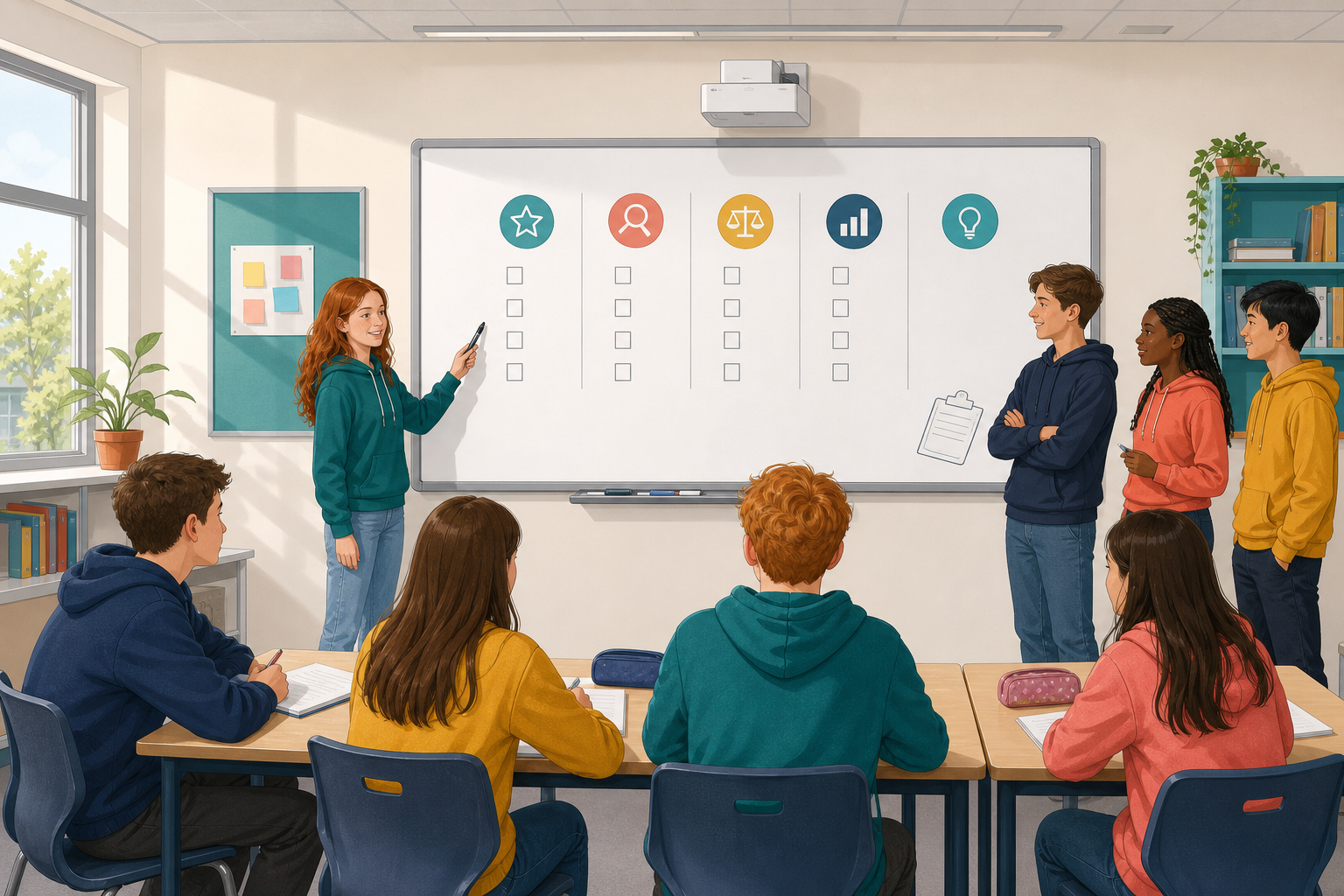
A good check is a question anyone can answer by looking at the source. The five areas are:
- Author: who made it, and what we know about them
- Purpose: why it was published (to inform, persuade, sell or entertain)
- Evidence: what it claims, and what backs that up
- Currency: how up to date it is, and whether that matters
- Cross-checking: whether other separate sources say the same thing
"Does it feel true?" gets struck out, because nothing on the page answers it. "Is the author's name and job on the page?" survives, because anyone can look and answer it.
Your group will make one source-evaluation card in the activity below, and its instructions explain the task.
- Agree on the wording out loud before anyone types it. If your group has to explain what a check means, it is not clear enough yet.
- Put your group's name on the card, so you will know it is yours when it comes back with checks struck out.
Your work saves as you go. You have twelve minutes, so make sure the card is finished, because at the end it goes to another group and they will not be able to ask you anything.
Your group's source-evaluation card
Now the cards move. Your teacher will tell your group which card you are testing and where to find it, and you will use that card to judge Source A below. You are not allowed to ask the group who wrote the card anything, because the test is whether the card works on its own.
Harbour View Youth Blog, posted 3 March 2024, by "Team HV" (no real names). Headline: "New study proves phones destroy sleep for every teen." It says "scientists now agree" that any phone use after 8 p.m. ruins sleep, and it quotes "Dr M. Byrne, sleep expert" with no workplace and no link. It ends with a button: "Buy NightShield blue-light glasses, 20% off this week." (These are glasses that claim to block the light from screens.) The post does not give the name of the study or the date of the research, and it does not link to anything else. A note at the bottom says the post may include sponsored content, which means a company may have paid to have things put in it.
- Go down the card one check at a time. For each check, mark yes, no or not sure, and write one line from the source that shows why.
- If a check makes you ask what it means, strike it out. To do that, cover the check using the Cover box button in the activity. Then write what the check would have needed to say for you to be able to use it.
- Hand the card back to its group with your strike-outs on it.
Make sure every check on the card you tested has either a yes, no or not sure with evidence, or a strike-out with a reason.
Now the class builds one checklist together. Only checks that survived the swap can go on it.
- Under each heading, the class picks the surviving check it likes best, from any group's card.
- If every check under a heading was struck out, rewrite one together now, using the reasons the testers gave for what was missing.
- One strong check under each heading is enough.
- Your teacher will save the list the class way, which means in the place where your class keeps its work. You will need it again in later lessons.
Our source-evaluation checklist
Unlock the full learning experience
You're previewing this lesson. Get full access to this lesson and hundreds more — each one ready to teach, with interactive activities, printable resources and pupil progress tracking built in.
This lesson is copyright of DigitalSkills.org 2017 - 2025. Unauthorised use, copying or distribution is not allowed.